North Carolina Residential Code for One and Two Family Dwellings
Many cities want to encourage the creation of accessory dwelling units (ADUs), which are small, secondary residences abreast or within a principal dwelling. Depending on region and style, these units can be called carriage houses, FROGs, pocket cottages, mortgage helpers, casitas, granny pods, garden apartments, trailers, English basements, and in-law suites, among other things.
A customs's success in creating ADUs depends on many factors, including local builders' feel, the size and layout of existing housing, and rental demand.
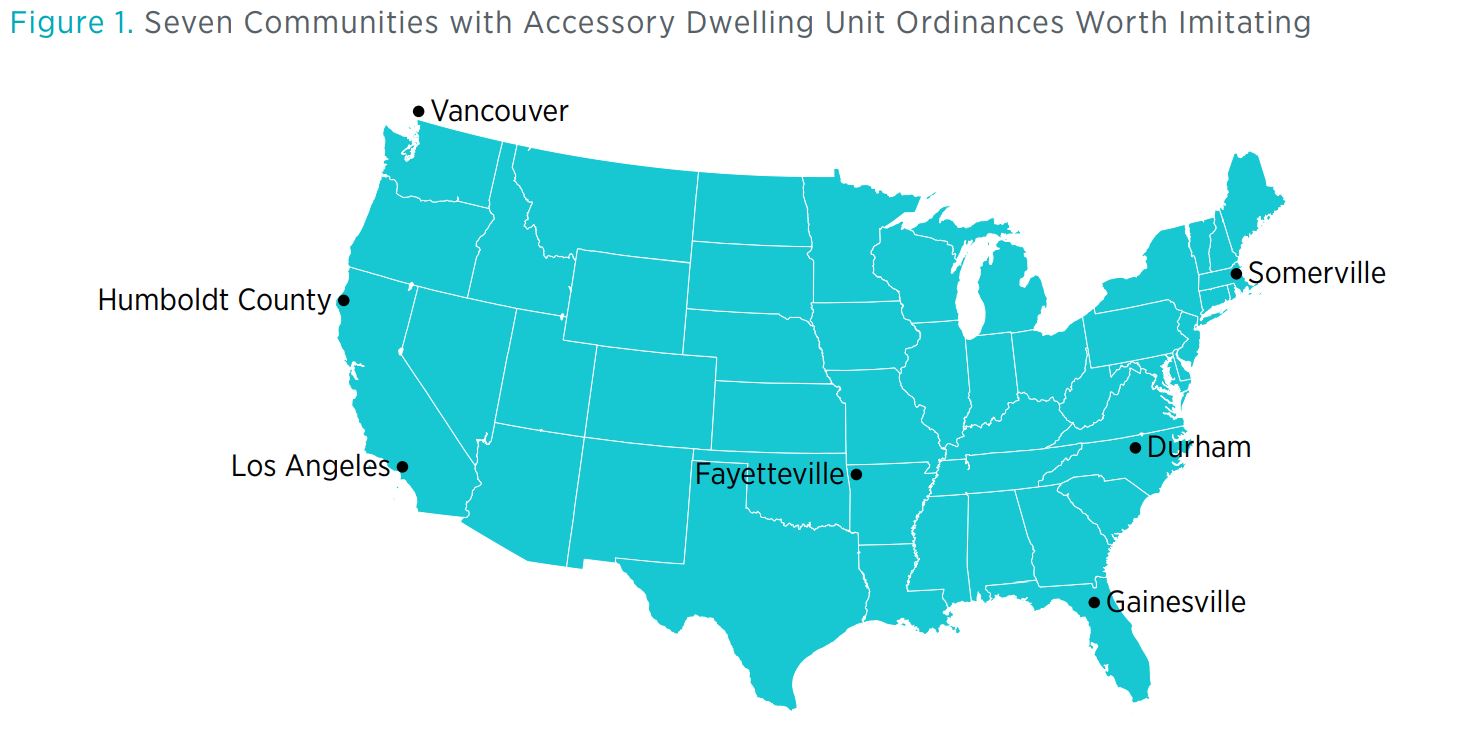
One necessary ingredient is an ADU ordinance that aligns with the local government's goal of creating ADUs. This policy brief describes 7 excellent real-world ADU ordinances that other governments tin accommodate. The model ordinances are from cities (and one canton) with differing development styles, wealth levels, and state regulatory environments. Although we looked all over the state, figure 1 (page 3) shows a clear pattern: West Declension communities and southern higher towns are the leaders in ADU ordinances.
What Makes a Successful ADU Ordinance?
The proof of the pudding is in the eating, and the proof of an ADU ordinance is in the permits. All else being equal, fewer restrictions consequence in more than permits. Of course, some aspects of an ordinance are more important than others. In tabular array 1, we highlight attributes of ADU ordinances that practitioners and researchers have identified equally the well-nigh of import. The best ordinances are those for which the following questions can be answered with a yes:
- Are new-construction, detached ADUs immune on lots of any size? Many ADUs are built from the ground up or manufactured off-site. Although interior ADUs, such equally basement apartments, are common in some places, well-nigh existing houses practise not have the space or layout for an interior ADU. Some cities allow only interior or attached ADUs or crave large lots for detached ADUs, which limits how many tin can exist built.
- Are separate rentals allowed? What about short-term rentals? None of our model cities require owner occupancy in order to rent the ADU and principal residence. The two units tin be rented to distinct households. And in some of our model cities, short-term rentals are immune, at least when there is an possessor-occupant in the master unit of measurement. ADU expert Kol Peterson argues that an owner occupancy requirement for long-term rentals is the greatest "poison pill" to ADU construction because it reduces the appraisement and resale value of an ADU. Without the power to finance construction costs and predictably recoup those costs at sale, few will build an ADU.
- Is parking market place-based? Unlike many jurisdictions, our model cities largely allow homeowners to provide as much or as lilliputian parking equally they choose. Parking spaces are costly and, in some cases, nearly impossible given the geometry of the lot. Existing garages are often candidates for ADU conversion. Homeowners, not regulators, are in a practiced position to judge their own parking needs. If street parking becomes scarce in certain neighborhoods, cities can manage demand by using parking permits, meters, or time-limited parking.
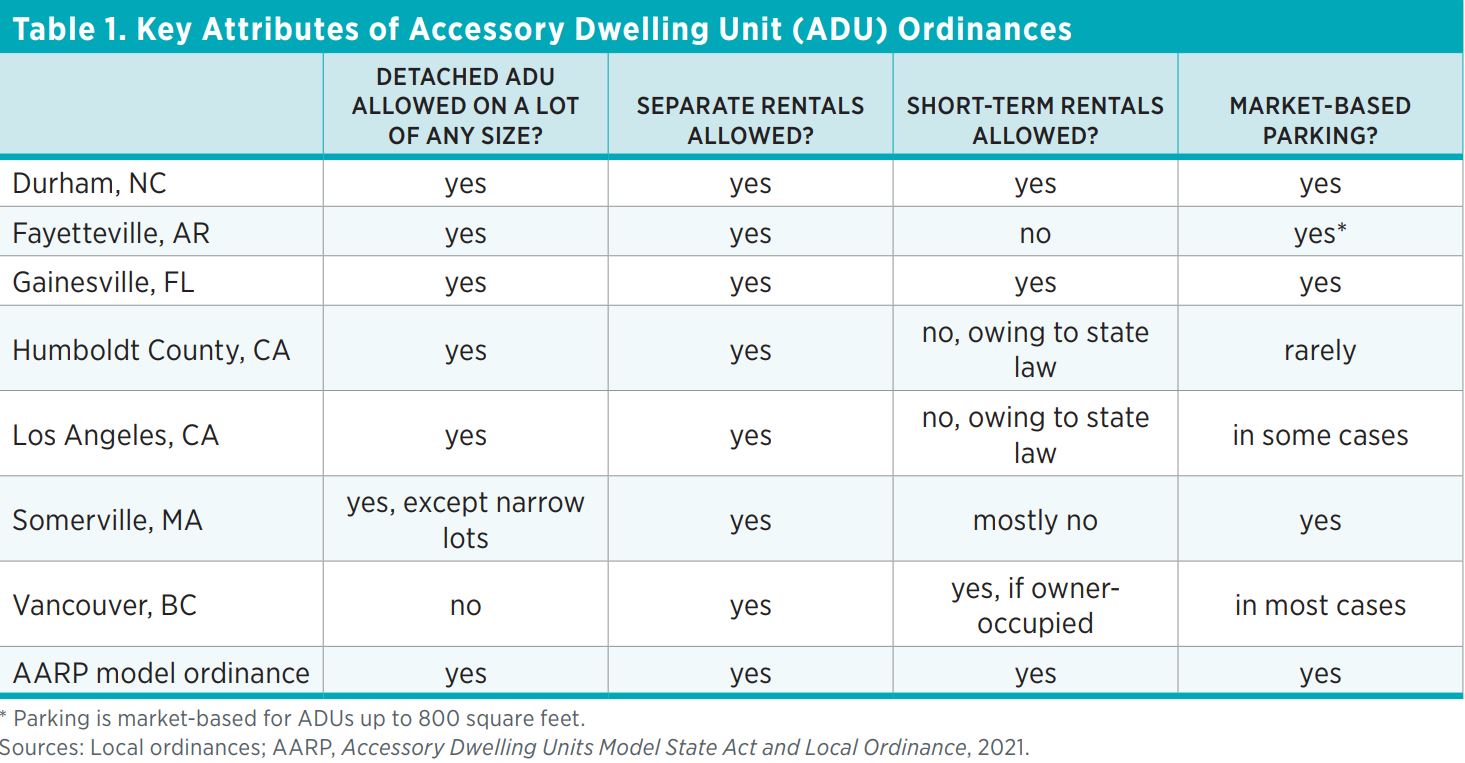 Tabular array 1 shows that the excellent AARP model local ordinance recommends a permissive stance on all these cardinal dimensions. In addition to providing suggested text, the AARP publication explains the tradeoffs and concerns associated with each topic.
 There are many other attributes of ADU codes, including permit costs, uncertainty, and building codes that can finer thwart new ADUs. For example, Austin, Texas, requires a rental ADU to have its own water meter and oft to upgrade the tap line—and the cost of that reportedly runs to $25,000 there.
Ane blazon of ADU restriction that does not appear to exist especially important is size. In Vancouver, discrete "laneway homes" are limited to 644 square feet on a typical, 33-foot-wide lot, but that has non prevented rapid structure. Nevertheless, context matters. The same limit would be suffocating if information technology were applied to Vancouver'southward interior "secondary suites," which oft occupy an unabridged floor of a house.
When drafting an ADU ordinance, city staff should select a representative sample of real country parcels and collaborate with local builders to mock upward a variety of ADU plans for each 1 using models mutual in similar cities. Then they should check the plans against the applicable lot coverage, setback, floor surface area ratio, elevation, and utility rules. If almost of the mock plans violate i or more regulations, the ADU ordinance is unlikely to be effective as drafted: information technology needs more than work.
Durham, Northward Carolina
Durham, the home of Knuckles University and N Carolina Primal University, takes a hands-off arroyo to ADUs. The city notes that in that location is no reliable count of the number of ADUs in its jurisdiction, though it does written report that 253 detached ADUs are included in the taxation ringlet. That number suggests that there is one detached ADU for every 490 single-family unit homes. Depending on how much of the ADU iceberg is invisible, in that location may be far more.
Durham has no owner-occupancy requirement, cheers to state instance law, and the city removed a minimum parking requirement for ADUs in 2017.
The urban center'due south ADU ordinance is a model of brevity, with fewer than 500 words. It gives the dimensional limits for ADUs, only it as well clarifies several freedoms, including "no additional parking is required" and "no special use permit is required."
Fayetteville, Arkansas, and Gainesville, Florida
Ii other southern higher towns—sites of the Academy of Arkansas and the University of Florida—recently amended their zoning codes to welcome ADUs.
Fayetteville allows the almost ADU square footage of any of our model cities, which makes sense given the large lots and low densities in much of the city. Not only does Fayetteville allow ADUs to be up to 1,200 square feet, it too allows two ADUs per lot—i internal, one external. ADUs to a higher place 800 square anxiety require boosted parking. The city is in the process of writing short-term rental regulations; such rentals have been technically illegal simply tolerated.
Gainesville's ordinance, like Fayetteville's, allows up to two ADUs per lot, although it caps the size at 850 square anxiety. Its 2020 reform is notable for what was struck from the code. Not merely did the city drop parking and owner-occupancy requirements, only as well it removed subjective style standards that required the ADU to be "consistent and compatible" with the principal dwelling. Gainesville likewise upgraded ADUs from "requires a special employ let" to "permitted by right" status in all residential zones.
Cities looking to welcome ADUs would practise well to follow Fayetteville's and Gainesville'south examples, not but in what code to add but in what to remove.
Humboldt County and Los Angeles, California
After a flurry of statewide laws promoting ADU development, every California jurisdiction now has rules friendly to ADUs. So the same basic rules apply in Humboldt County's secluded valleys and on the boulevards of Los Angeles. However, the different contexts hateful that ADUs are congenital differently and each jurisdiction focuses on local needs.
Humboldt Canton welcomes ADUs in all forms: moveable tiny houses, park model RVs, and HUD Lawmaking manufactured homes, in addition to the usual site-built and prefab options. Moveable tiny houses and park model RVs, which are likewise permitted in Los Angeles, are required to follow the condom standards for RVs rather than the building code. Both localities impose design regulations that are unnecessarily strict and rule out some custom-built tiny homes, but the regulatory framework provides clarity and flexibility.
While Humboldt County'southward approach is a natural model for other rural counties and small towns, Los Angeles shows how an ADU market tin can mature when information technology reaches critical mass.
In Los Angeles, ADUs are ofttimes sometime garages (see figure 2), taking advantage of the city's most abundant grade of underused space. In other cities, about garages prove to be uninhabitable. The dry Los Angeles climate may permit garages to avoid the mildew and decay that occur elsewhere.
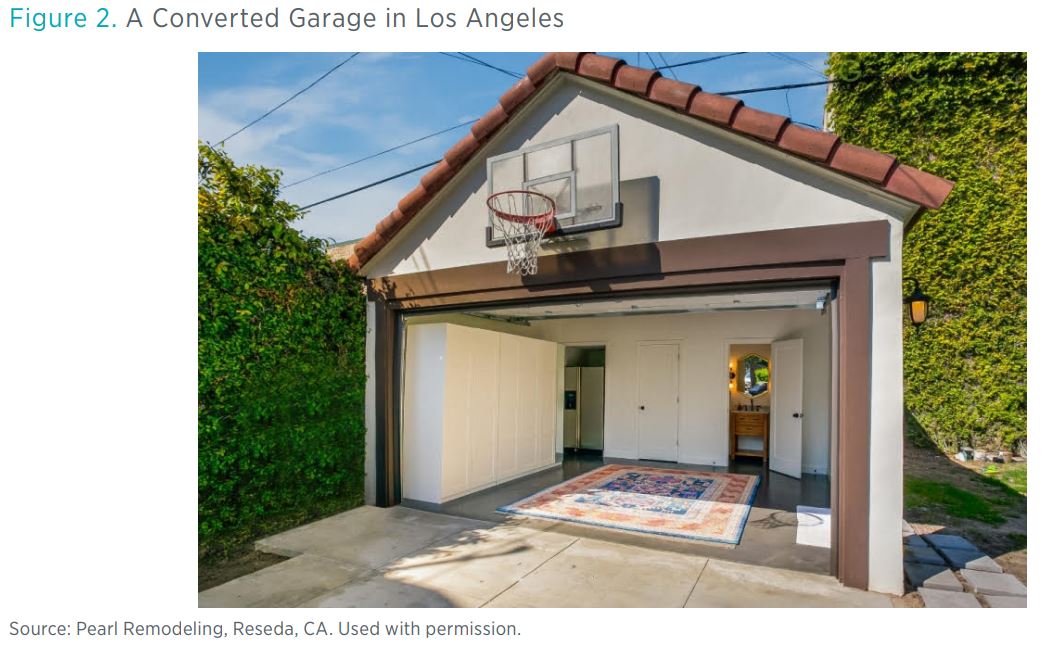 At least a dozen Los Angeles–area contractors now specialize in garage conversion. With specialization and experience come competence and savings, farther boosting demand for ADU structure.
Under California law, ADUs face no owner-occupancy restriction or minimum lot size requirement, and cities do non require boosted parking under certain circumstances, such as if the belongings is within a half mile of a bus finish. In addition to a full-size ADU, each homeowner can also provide a "junior ADU," an interior or attached space of upward to 500 square feet that may share sanitation facilities with the main unit. Unfortunately, country law confined brusk-term rentals in ADUs.
Los Angeles goes beyond country police past allowing detached ADUs to be upwards to 1,200 square feet and ii stories tall.
Somerville, Massachusetts
The smallest (and densest) municipality in Massachusetts made headlines in 2016 when it announced that merely 22 buildings in its residential zones were compliant with the zoning. The finding helped unite the city behind a wholesale rezoning, and information technology adopted a form-based code that brought the law into conformity with the built environment. Unlike traditional zoning codes, form-based codes define each commune effectually concrete characteristics such as elevation and frontage manner.
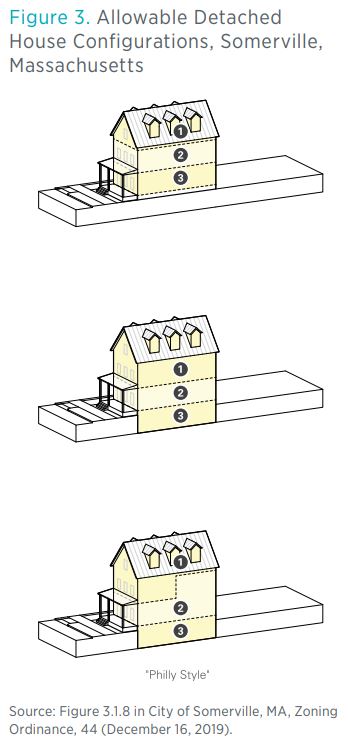
Somerville'southward reform erased the distinction between "accessory" and "principal" dwellings by allowing up to 3 dwelling units in all types of residences. Figure 3 shows different configurations allowed in a discrete house, including basement apartments that would be considered ADUs in many other cities.
 The form-based code too makes provision for "lawn cottages," which can have up to 576 square anxiety on the ground floor and a half-story loft. On lots without burn truck access via driveway, street, or alley, a lawn cottage is required to have a sprinkler organisation. The narrowest lots—beneath 32 or 34 feet—cannot have lawn cottages.
Somerville'due south treatment of unit of measurement counts and backyard cottages is much clearer than that of some well-known form-based codes, such as the code of Buffalo, New York. Somerville also avoids the common form-based lawmaking pitfalls of micromanaging appearance and having distinct requirements for many small districts. At that place is one potential source of confusion, though: Somerville uses "ADU" as an abridgement for "affordable dwelling unit," an unrelated concept.
Cities with class-based codes tin can benefit from adopting Somerville's approach.
Vancouver, British Columbia
Canada's westward coast city is the unrivaled ADU capital of North America considering citizens took matters into their ain hands. Like New York lofts, early Vancouver "secondary suites" were illegally tucked into existing buildings.
Starting in the 1960s, local builders capitalized on the tendency by designing homes—at present known as "Vancouver Specials"—specifically to accommodate large, unpermitted basement apartments.
Sightline Constitute founder Alan Durning chronicled the city's gradual acceptance of secondary suites. In early customs meetings, "[neighbors] raised all the objections still apposite whenever renters appear in single-family unit zones: parking, noise, 'loss of character,' crowding and safety." Kol Peterson notes that the metropolis had no choice but to take the reality of widespread secondary suites; otherwise "tens of thousands of residents would [have been] without housing." One stride at a fourth dimension, the metropolis moved toward selective tolerance, and then broad acceptance, and finally encouragement.
Today, fifty-fifty a condo in a high-rise can legally take an ADU, provided that it has a separate door. Secondary suites contain the vast majority of Vancouver's well-nigh 30,000 ADUs.
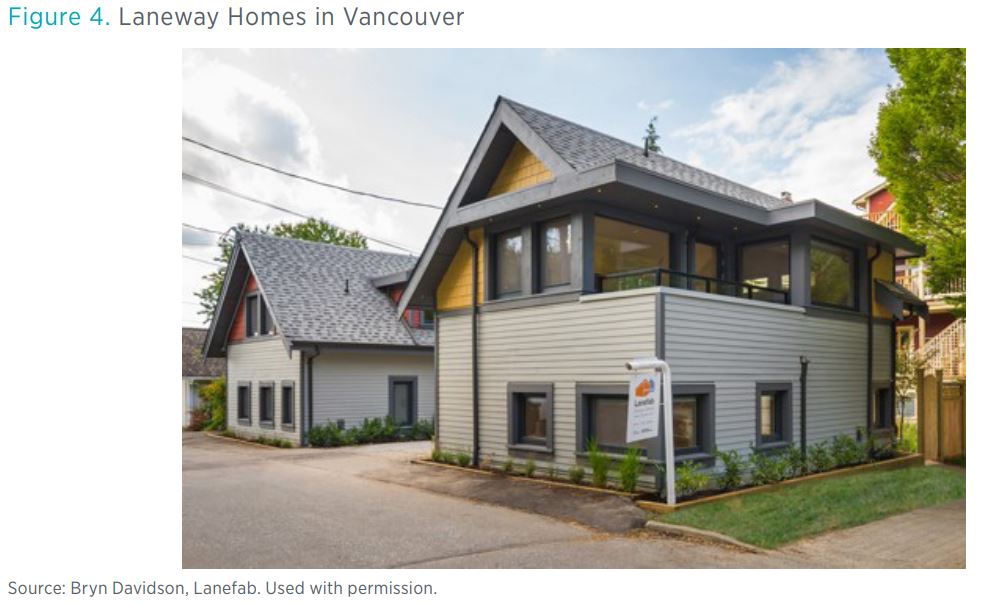
Yet, detached "laneway homes" such every bit those in effigy iv are more visible and are becoming more common. From 2012 to 2017, 20 percent of sales of newly built houses included a laneway domicile. As the proper name suggests, laneway homes back upward to an alley, assuasive residents to come up and become without passing the chief residence.
Vancouver regulates laneway homes more strictly than secondary suites. The city'due south dimensional limits scale with the width of the lot, and information technology caps height at 1.5 stories. Parcels narrower than the metropolis norm and those on which the principal dwelling is large and set back from the street, including well-nigh Vancouver Specials, cannot have a laneway home.
 Although Durham'southward or Gainesville's hands-off approach is best for cities where ADUs are relatively new, Vancouver'due south guided permissiveness is informed by extensive local experience identifying what works in its ain context. Cities looking to follow Vancouver's regulatory approach should do so by analogy rather than direct false. Like Vancouver's planners, they should tolerate early experimentation, carefully heed to builders and ADU residents, and promote models that accept proved successful.
Farther Resource
A clear and permissive ADU ordinance is only one of the ingredients necessary for a healthy ADU structure charge per unit. We recommend the following resources to ameliorate understand the private sector, outreach, and process aspects of an environment conducive to ADU growth:
- AARP, Accessory Home Units Model State Act and Local Ordinance, AARP, 2021.
- ADU Best Practices Webinar Series, Casita Coalition (California).
- ADUniverse (website), City of Seattle, https://aduniverse-seattlecitygis.hub.arcgis.com/.
- Christina Stacy et al., "Designing Accessory Dwelling Unit Regulations: Recommendations for the City of Alexandria, Virginia" (report, Urban Constitute, Washington, DC, November 2020).
- Metropolis of Vancouver, Laneway Housing How-To Guide, Nov 2016, https://vancouver.ca/files/cov/laneway-housing-howto-guide.pdf.
- City of Vancouver, Looking to Create a Secondary Suite in Your Home?, 2019, https://
- vancouver.ca/files/cov/secondary-suite-how-to-guide.pdf.
- Karen Chapple et al., "Jumpstarting the Market for Accessory Dwelling Units: Lessons Learned from Portland, Seattle, and Vancouver," (report, Urban State Institute San Francisco, 2017).
- Karen Chapple et al., "Reaching California'south ADU Potential: Progress to Engagement and the Need for ADU Finance" (written report, Terner Center for Housing Innovation and Center for Customs Innovation, UC Berkeley, Baronial 2020).
- Kol Peterson, Backdoor Revolution: The Definitive Guide to ADU Development (Portland, OR: Accessory Habitation Strategies, 2018).
Determination
ADUs may be the most context-dependent course of housing. The "Vancouver Special" basement apartment, Los Angeles garage conversion, and Fayetteville modular unit all depend on a preexisting development pattern with plenty space to add an ADU.
Almost of the model ADU ordinances promoted in this policy brief are of very recent vintage, reflecting the rapid acceptance of ADUs. Past 2030, cities and researchers may know much more about what works best in various contexts.
Given these unknowns, the approach taken by Gainesville and Somerville, cities with few existing ADUs, is beauteous: first they removed nearly restrictions, and now they tin can respond to their residents' creativity and initiative with resource or regulatory tweaks that promote the most successful local forms and that address unforeseen problems if any arise.
Source: https://www.mercatus.org/publications/land-use-regulations/ordinances-work-seven-communities-welcome-accessory-dwelling-units

Post a Comment for "North Carolina Residential Code for One and Two Family Dwellings"